After the breach: what happens to your credentials in the 18 months that follow
The breach notification email, when it finally arrives, feels like the beginning of the problem. In reality, it's closer to the middle. By the time you're told, your data has usually been working against you for months.

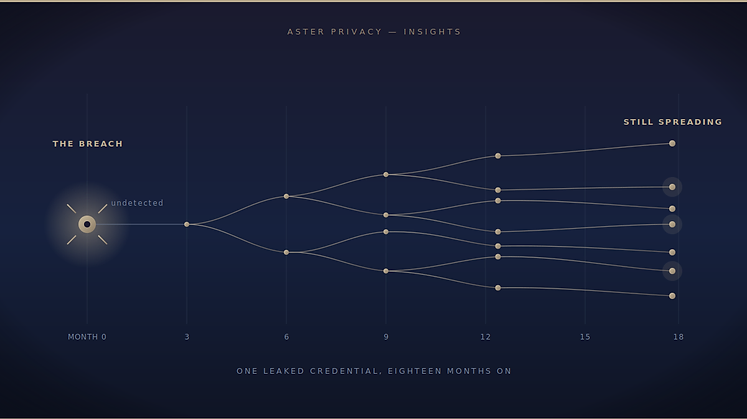
There's a comforting assumption tucked away in how most of us think about data breaches — that we'll find out when one happens. We won't. More often than not, you learn about it long after the fact, if you learn about it at all. And that gap, between the moment a breach occurs and the moment anyone notices, is one of the most consequential facts in personal digital risk. It's also one of the least understood.
The numbers are sobering. According to IBM's 2025 Cost of a Data Breach Report, cited by the breach-monitoring firm Breachsense, "the average breach takes 241 days to identify and contain. That's eight months of unauthorized access before anyone notices." Eight months. And that's the average — the well-behaved middle of the distribution. Some breaches run far longer; healthcare incidents have averaged closer to nine months, and the outliers stretch into years.
Why does it take so long? The answer, once you hear it, is uncomfortably simple — because the attacker often isn't breaking anything. They're logging in. As Breachsense puts it, drawing on Verizon's 2025 Data Breach Investigations Report, "88% of basic web application breaches involve stolen credentials. Attackers don't need to exploit vulnerabilities when they can just log in." And a legitimate login doesn't trip any wires: "when an attacker logs in with a real username and password, your SIEM sees a successful authentication. Your firewall sees normal traffic. There's no malware signature to detect. The attacker looks exactly like the employee whose credentials they stole." The most common way in is, by design, invisible to the tools meant to catch it.
Now think about what your data is doing during those eight silent months — because it certainly isn't sitting still. SQ Magazine's investigation into the post-breach economy describes a brisk, tiered market that most victims never see. In the earliest window, it reports, stolen records "flow through invitation-only forums and Telegram channels rather than open marketplaces," and the buyers are few: "three to five operators per batch, who pay a premium for unprocessed records and run automated checks to identify which credentials still work." Freshness is everything — the same research notes that records "older than 60 days" are "routinely discounted by 70 to 80% compared with same-week leaks." Your credentials, in other words, are a perishable commodity, and the clock starts the moment they're taken. And it starts fast: Breachsense notes that "infostealer malware publishes stolen passwords on dark web markets within hours." Not months. Hours.
Here's the asymmetry that ought to worry anyone. The attacker works on a timeline of hours and days. You — the person whose credentials were actually stolen — work on a timeline set by breach-notification law, which crawls from weeks into many months, especially when the breached company is some vendor three or four steps removed from you, someone you may not even know holds your data. The gap between those two clocks is where the damage lives.
So why eighteen months? Not because any single report measures it — the sourced detection figure is those eight months. Eighteen is the fuller arc, once you add the lag before public disclosure and the long tail that follows. And that tail is real. As SQ Magazine describes it, stolen records don't get used once and discarded; they get "recycled into credential-stuffing combolists" and given "a permanent afterlife in breach-aggregator databases." A password taken from you today may not be tried this week. It might surface in a credential-stuffing run next quarter, or get folded into an identity package and sold — a year from now — to someone quietly assembling a picture of you.
For a principal, this quietly rewrites what "being safe" even means. The absence of a notification in your inbox is not evidence that your credentials are secure. It may just mean the breach that exposed them hasn't been detected yet — or that the paperwork is still grinding through a disclosure process measured in months. The only way to actually know whether your credentials are exposed is to go and look at the places they'd surface, on purpose, rather than waiting politely for a company to get around to telling you.
That's the whole logic behind proactive exposure assessment and ongoing monitoring. Finding your credential sitting in a breach dataset isn't the end of a story — it's the start of a narrow, closing window, one in which the right move made quickly can shut the door before the data finishes its trip through the criminal economy. The alternative is the way most people find out: from the consequences, long after anything could have been done cleanly.
So here's the question worth sitting with. If your credentials had been exposed eight months ago, would you know today? Answered honestly, for most people the answer is no. And that "no" is exactly where the harm takes root.
This article discusses breach timelines and credential exposure in general terms. It's educational, not individual advice.
Sources
- Breachsense — Data Breach Detection (IBM 2025 & Verizon 2025 DBIR figures; the 241-day average and the "just log in" mechanics)
- Robert A. Lee, What Happens to Your Data After a Breach — SQ Magazine (resale lifecycle, buyer behaviour, freshness pricing)
- IBM — Cost of a Data Breach Report 2025 (primary source for the 241-day figure, via Breachsense)
- Verizon — 2025 Data Breach Investigations Report (stolen-credential share of web-app breaches, via Breachsense)
This piece was written by the founder of Aster Privacy, a Singapore-based protective-intelligence firm working discreetly with principals, family offices, and executives. Aster Privacy is led from a dual vantage point: an active background in executive protection — the close protection of principals, public figures, and their families — combined with the digital-exposure work that increasingly determines physical risk. The firm maps what is discoverable about a principal across the open web, dark web, and Chinese-language platforms, and translates it into practical protection. By referral and appointment.