What someone can actually do with your name, NRIC, and a leaked password
A name, an NRIC number and a leaked password don't look especially sensitive on their own. The risk changes entirely when you put them together. In the wrong hands, that combination is enough to support account takeover, impersonation, and access to services that still lean on personal information to verify who you are.

People tend to underestimate a leaked credential, and it's easy to see why: nothing happens when it leaks. There's no alarm, no visible consequence. A password can sit in a breach dataset for months — sometimes years — before it's ever turned against the person it belongs to. That silence is the trap. It reads as safety when it's really just a delay.
The trouble usually starts with a habit almost everyone has: password reuse. Most of us recycle the same password, or a lightly tweaked version of it, across a dozen services. Attackers know this, and they've built an industrial process around it called credential stuffing. The OWASP Foundation, the reference authority on web-application security, defines it precisely — "the automated injection of stolen username and password pairs ('credentials') into website login forms, in order to fraudulently gain access to user accounts." The reason it works is almost mundane: a password exposed by one breached service is very often still valid on another. Large lists of stolen credentials get tested automatically against email providers, social platforms, online stores, banking portals — anywhere the same login might have been reused.
And note what this doesn't require. There's no clever exploit, no software vulnerability being prised open. In most cases the attacker is simply logging in with real credentials that happen to belong to you, and letting automation grind through enough combinations to find the accounts where the reused password still opens the door.
Why the email account is the real prize
Of all the accounts a leaked password might open, one matters far more than the rest — the email inbox. Not because of what's in it, though that matters too, but because of what it controls. Email is the recovery mechanism for almost everything else you own online.
Get into someone's inbox and you can start requesting password resets across the accounts tied to that address — and depending on the person, that can mean banking and investment platforms, cloud storage, telecoms accounts, even government-linked services. OWASP notes this directly among the technique's consequences: attackers can use the access to reach "sensitive information," and to turn compromised accounts into launchpads for "phishing messages or spam."
Then there's the intelligence sitting in the inbox itself. The messages quietly reveal which bank someone uses, where their accounts are held, what they bought last week, where they're travelling next, who their lawyer and accountant are. Each of those details makes the next move — a convincing impersonation, a tailored fraud — that much easier to pull off. And a careful attacker can delete the reset notifications and security alerts on the way through, so the owner sees nothing until it's too late. For a principal, an executive, or a family member with a wide web of financial and professional relationships, losing the primary email account is rarely contained to email.
Where the NRIC comes in
In Singapore, the NRIC number adds a second dimension — and to understand why, you have to separate two ideas that are easy to blur.
For years, NRIC numbers were used not only to identify people but, carelessly, to authenticate them. That distinction is the whole point. As the Ministry of Digital Development and Information has framed it, the responsible use of NRIC numbers "requires organisations to distinguish clearly between identification (confirming who someone is) and authentication (proving that the person presenting themselves is who they claim to be)." An NRIC number does the first job. It was never fit to do the second. Knowing the number tells you which person a record belongs to; it proves nothing about whether the person reciting it is actually them.
Singapore's regulators have now made that principle enforceable. Following the June 2025 joint advisory from the Personal Data Protection Commission and the Cyber Security Agency, the PDPC moved from guidance to rule. Baker McKenzie summarised the position plainly: "private organisations must cease using full or partial NRIC numbers for authentication by 31 December 2026," and "beginning 1 January 2027, the PDPC will step up enforcement, including issuing directions or financial penalties for continued misuse." The prohibited practices are named specifically — using NRIC numbers "as passwords, login IDs or default credentials, including combinations with easily guessed personal data." And the advisory closed the obvious loophole too: as the summary of its guidance put it, "a person may not be who he claims to be just because he is able to state that person's NRIC number." Which is the entire lesson in a single sentence.
The danger is in the combination
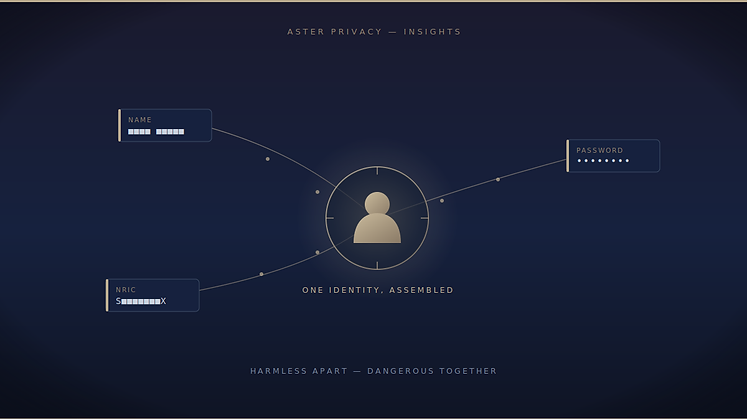
Here's the thing to hold onto: no single item on this list is the problem. The name is semi-public. The NRIC has been handed to dozens of legitimate organisations over the years. The email address is probably on a professional profile somewhere. The password is "just one account." Each looks survivable on its own — which is exactly why the combination gets underestimated.
Lay them side by side, though, and a chain appears. Picture an attacker holding four things: a name, an NRIC number, an email address, and a password once used with that email. The password opens an account directly, or hints at a pattern worth testing elsewhere. If it opens the email, the attacker now sees the person's whole financial and professional landscape and can start recovery processes across it. The name and NRIC then lend weight to impersonation attempts against any organisation still leaning too hard on static personal details to verify a customer — and the specifics harvested from the inbox make those attempts sound authentic.
The telco is the classic pressure point. If an attacker can seize a mobile number through a SIM-swap or an account-recovery con, the SMS one-time codes protecting everything else start arriving on their device instead. A layer of security you thought you had quietly becomes a layer working against you.
None of these steps is guaranteed to land, and well-designed controls should stop most of them. But that's the uncomfortable asymmetry: the attacker doesn't need every step to work. They need one weak link — one service provider, one recovery process, one reused password — in a long chain of interconnected accounts.
The exposure is hard to see — which is the point
What makes this genuinely difficult is that almost none of it is visible to the person affected. A password landing in a breach dataset sets off no alarm. An NRIC number may have been shared, legitimately, with dozens of organisations over a lifetime. An email address is often just… public. Individually, none of it looks like an emergency.
The hard question isn't whether any single password or identifier has leaked. It's whether enough has quietly accumulated — and started to overlap — to build a credible picture of a person and turn it against the accounts they depend on. That's what a digital exposure assessment is actually for: checking known breach exposure, identifying compromised credentials, reviewing what personal information is publicly available, and working out whether the combination opens realistic routes to account takeover or impersonation. Where it does, remediation can focus where the risk is genuinely concentrated — rotating reused passwords, hardening authentication, fixing weak recovery methods, locking down the email account, and trimming back the personal information that didn't need to be exposed in the first place.
The aim isn't to assume that leaked data will inevitably become fraud. It's to see what's already out there and quietly remove the preventable weaknesses before someone else finds them first. Because for most people, the first sign that their information has been assembled this way is the moment an account, a phone number, or an identity has already been targeted. Finding it earlier means dealing with it on your own terms, rather than theirs.
This article discusses identity and credential exposure in general terms. It's educational, and doesn't constitute individual security or legal advice.
Sources
- OWASP Foundation — Credential Stuffing
- Ministry of Digital Development and Information — Responsible Use of NRIC Numbers Across Public and Private Sectors
- PDPC & CSA — Joint Advisory Against Using NRIC Numbers for Authentication (June 2025)
- Rajah & Tann Asia — summary of the PDPC–CSA joint advisory
- Baker McKenzie — Singapore: PDPC to Ban NRIC Authentication Use by End-2026
This piece was written by the founder of Aster Privacy, a Singapore-based protective-intelligence firm working discreetly with principals, family offices, and executives. Aster Privacy is led from a dual vantage point: an active background in executive protection — the close protection of principals, public figures, and their families — combined with the digital-exposure work that increasingly determines physical risk. The firm maps what is discoverable about a principal across the open web, dark web, and Chinese-language platforms, and translates it into practical protection. By referral and appointment.