Why digital exposure is now a physical-security problem
Information that once sat outside the protection team's remit can now affect residential, travel and family security. Online exposure and physical protection increasingly need to be assessed together.
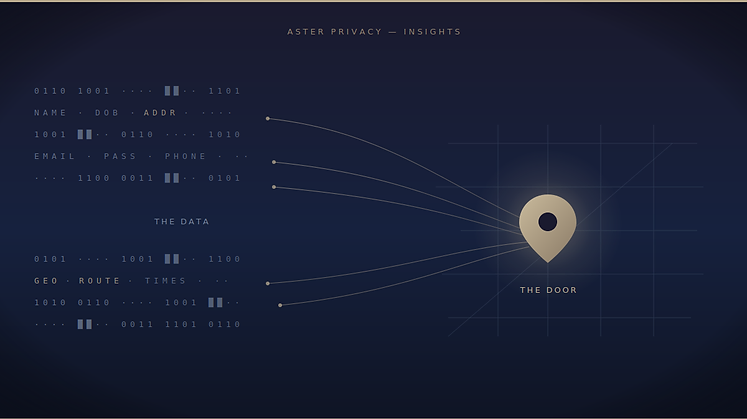
There was a time when a determined person who wanted to find out where a principal lived had to physically tail them home. Today, in theory, they could simply buy your address online.
The shift is not subtle, and it is not coming — it has arrived. Security researchers now describe a clear pipeline in which an executive's home address or travel plans, once leaked online, make them vulnerable to targeted approaches at their residence or in transit. In short, this means that the digital exposure is the reconnaissance; the physical incident is the consequence.
In a 2026 research report by the human risk management company Nisos, it was found that a large majority of executives across a range of industries and locations have had their personal information sitting in public records, and that more than half appeared in data breaches — the raw material for locating a person in the physical world. The same body of research found that roughly a third of executives or their family members had leaked geolocation and pattern-of-life information through fitness apps and public, geotagged posts — the kind of data that lets someone establish not just where a principal lives, but when they are likely to be there, and when they are not.
Acquiring such information like the aforementioned does not require breaking into anything. Threat actors are able to use publicly available information to locate individuals, map their properties, establish their routines, and identify when their homes are unoccupied. The information is simply there, aggregated and sold by an industry of data brokers, waiting to be assembled by anyone with the patience to do it.
And the consequences are no longer theoretical. Analysts at ZeroFox and Forbes Technology Council have found through tracking executive risk that there have been documented cases in which online threats directly preceded real-world approaches — a convergence that one industry report described as a structural shift, where digital exposure now translates rapidly into physical vulnerability. The most sobering illustrations involve principals targeted at their residences using addresses that were never secret, only discoverable.
This is precisely why the discipline of close protection and the discipline of digital intelligence should not be mutually exclusive. A protection detail that secures the residence but never checks what the open web reveals about that residence is guarding a door, while the map to it circulates freely. The reverse is equally true: a digital assessment that surfaces an exposed address but never asks what it means for the principal's physical security, has stopped one step short of the point.
At Aster Privacy, this is the premise of the work. We map what is discoverable about a principal across the domains they cannot easily see — and where a digital finding carries real-world consequence, we say so, and advise on what it means for their personal security. The exposed address, the discoverable routine, the pattern of movement assembled from public posts: these are not abstract privacy concerns. They are the opening moves of a physical threat, and they are visible long before anything happens — if someone is looking.
The question is not whether a principal's digital exposure could become a physical problem. For anyone of sufficient profile, it already is one. The only variable is whether it has been seen, and what is being done to circumvent the possible damages it may bring.
This article discusses digital exposure and physical security in general terms. It is educational, not individual advice.
Sources
This piece was written by the founder of Aster Privacy, a Singapore-based protective-intelligence firm working discreetly with principals, family offices, and executives. Aster Privacy is led from a dual vantage point: an active background in executive protection — the close protection of principals, public figures, and their families — combined with the digital-exposure work that increasingly determines physical risk. The firm maps what is discoverable about a principal across the open web, dark web, and Chinese-language platforms, and translates it into practical protection. By referral and appointment.